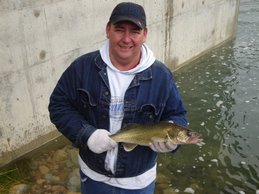
Wow this looks like a lotta lotta fun..I wish I could be there..They have been catching some realcorkers lol..
Come and have a look at Hunter's Big Fish - Shuswaps 2004.
They cought some massive Fish!!!
Tuesday, October 30, 2007

Friday, October 26, 2007
Here is a great recipe that I love to cook..

Ginger bass, salsa trout microwave special..
Thin pieces of fish steam to moist succulence in just minutes in a microwave. Heat penetrates their slim profiles quickly and evenly. For light, lean, and flavorful results, complement the fish with bright seasonings: orange, ginger, and cilantro with seabass; fresh salsa with trout; lemon and capers with sole. Each of these recipes cooks in about 2 minutes and serves I or 2 people. For more servings duplicate recipe, cooking each dish separately. Microwave-steamed Bass with Ginger
1/2 pound white seabass fillets (1 to
1 1/2 in. thick)
1 tablespoon orange juice
2 teaspoons soy sauce
1 teaspoon fine shreds fresh ginger
1/2 teaspoon fine shreds orange peel
Fresh cilantro (coriander) sprigs
Orange wedges Cut fillets crosswise into 1-inch-wide strips. To butterfly fish, cut down the center length of each strip almost all the way through, then open out flat. Set butterflied fish pieces on a 9- to 10inch nonmetal plate and drizzle evenly with orange juice and soy. Sprinkle ginger and orange peel evenly over fish. Cover with plastic wrap. Place dish in a microwave oven and cook at full power (100 percent) until fish is slightly translucent but still moist in thickest part (cut to test), 2 to 3 minutes. Garnish with cilantro and squeeze orange over fish to taste. Serves I or 2. Per serving: 1 18 cal.; 21 g protein; 2.3 g fa t,- 1. 6 g carbo.; 421 mg sodium; 4 7 mg
Friday, October 5, 2007
Inflatable Boats: An Overview

Inflatable boats are made from flexible material, usually rubber, canvas, or neoprene, and hold air at high volume but low pressure. They need to be fitted with a frame to which an oarlock mount is firmly attached. Such frames are either made of metal or wood, or a combination of the two.
Inflatable boats with motors are high speed, maneuverable, stable and can be easily launched from a ship. For this reason, US Navy SEAL’s use the inflatable boat small (IBS) for their operations.
Twenty-three foot long Rigid Hull inflatable boats are best suited for retrieving people stranded on rocky pinnacles among the waves, and are used by the US Coast Guard during Search & Rescue operations.
There has been a lot of development in Inflatable boats. The large inflatable boats have rigid boards in them, and are called Rigid Inflatable Boats (RIB’s). They can be driven by oars or outboard engines. The large ones are considered good enough to be used by the Lifeboat men.
The modern life raft is a well thought out, well-equipped, seaworthy fully inflated boat. However, if there isn’t enough air inside, inflatable boats are apt to fold in the middle. Thus, they need to be pumped up to the proper pressure using bellows.
Most Inflatable Boats are portable rafts. An inflatable yacht that is 8 feet (2.4 m) long is rated to carry three people when used with a motor. It weighs 35 pounds (15 kgs.) when dry, which makes it a reasonable load for one person to carry for a long distance if necessary. The next size is 9 feet long, which does not sound much more, but the difference is great, in fact. The 9 feet boat is heavier and has much larger air tubes.
People use inflatable boats for exploring, and manually haul them to remote places. There are many brands of high quality inflatable boats available in the market, but whatever brand is chosen should be roughly 8 feet long, rated for 3 people, have a motor, be a reasonable load for one person to carry, and does not have a wooden floor, or other heavy parts.
Inflatable Boat Sales are taking place online. Inflatable boats are available for sales – both as new ones, and as used boats. Prices range from $25 right up to $2,800. The range covers 8-foot yacht tenders, fishing boats, and 14-foot inflatable sail boats.
Dale
http://dalesblogs.blogspot.com/
http://unityblog1.blogspot.com/
http://unityberrytree.blogspot.com/
http://www.MyBerryTree.com/bt53423
Tuesday, September 25, 2007
Fly Fishing Rods – Getting The Bends

Picking a fly fishing rod is a tricky endeavor. Do you go with your ego, expected fishing environment or something else? While length is a factor, the bend or action of the rod is a key factor.
Flexibility
Fly fishing rods are often defined by their flexibility. In laymen’s terms, flexibility means how far the rods will bend when the same casting effort is used.
Minimal Bend
A fly fishing rod that has minimum bend is often called a “fast” rod. The lack of bend lets the angler get lots of speed on the cast. This speed allows you to cast very accurately and farther away than rods with more bends. While these benefits may sound great at first glance, a fast rod can be frustrating. There is no room for error when using the rod. If you are going to use one of these rods, you need excellent motion and timing. Generally, only anglers with a lot of experience should have a go at using fast rods.
Moderate Bend
The next step down from a fast rod is one with medium flexibility. These rods tend to have good flexibility, but the bend is restricted to the top half of the rod. The rod requires less perfection of motion and timing, but is fairly accurate. If you’ve been angling for a while and have the basic techniques down, a moderately flexible rod is worth a try.
Slinky Bend
If you are just taking up fly fishing, you should use a rod with maximum flexibility. While others suggest a moderate bend is better for beginners, a “slinky bend” rod gives you a lot of leeway when it comes to learning to cast.
Fly fishing is relaxing and enjoyable. Pick the wrong rod, however, and it can quickly become frustrating and stressful. If you use your brain, not your ego, when picking a rod, you will have a blast.
Dale
http://dalesblogs.blogspot.com/
http://unityblog1.blogspot.com/
http://unityberrytree.blogspot.com/
http://www.MyBerryTree.com/bt53423
Sunday, September 16, 2007
Surface Fishing Twitch Baits - 101

First off, what is a "twitch" bait? I first heard this term from my Brother-In-Law when he saw me catching fish on one and mumbled, "I never could catch anything on those twitch baits." A twitch bait is really nothing more than a floating crankbait with a very small lip.The bait runs a few inches under the surface with a steady retrieve and returns to the surface when the retrieve is stopped. Some examples would be the original Rapala(tm), or some of the floating Yo-Zuri(tm) lures but there are many models and brands, so pick your favorite.
How do you fish it?
Now onto the important part, how to fish the bait as a "twitch" bait. This is a real simple method but it requires some imagination. The whole idea is to imitate a dying fish on the surface. You've all seen them, those fish that make a few ripples on the surface and then swim a foot or so before returning to the surface again due to exhaustion. This is no different. I fish it in different areas depending on the time of day and weather. One thing though, if its real windy out skip the small twitch bait and move to something that runs underwater or makes a bigger surface disturbance. Basically you will want to cast the bait and let it sit until the rippes settle. Be ready for a strike though, because I have had fish hit the lure when it first lands on the water. Give it a quick jerk to make it dive forward and then let it surface. Twitch it a couple of times on the surface to make it ripple but not move. Repeat and mix up this process. Sometimes I will give it two or three jerks to make it jump forward underwater. Other times I will twitch it just enough to move it forward over real shallow weeds to the next open hole. Here are the areas I concentrate on depending on the time of day.
Night to Early Morning Locations
When fishing one of these baits early in the morning I will fish shallow weed edges or flats with some kind of cover. Usually you will be seeing the tail-end of the night feeding crowd that has been out on the prowl. As the light gets brighter they will move closer to structure for ambush possibilities.
Mid-Day Locations
Here is where you get to test your casting skills. Move up towards the thick weeds that have open pockets. Start casting to the close pockets and work your way out. Move the boat quietly to avoid pushing the fish to other cover. If you don't cover all of a pocket on the first cast then throw back again, the fish might not move far from cover to get their meal.
Evening to Night Locations
Start moving towards the weed edges and flats again. The edges near the cover that you fished in mid-day seems to usually produce. I have fished these baits with success at night but usually move on to Jitterbugs for surface work and Texas-Rig worms for fishing structure. I will write an article soon on my experiences with night Bass fishing.
Conclusion
Hopefully I haven given you some ideas of what to do with those lures. It works for me and is my fallback method when all else fails. The idea is simple, you just have to work at until you get the technique. Feel free to email me with questions or comments about this article, or post your questions in the forums.
Dale
http://dalesblogs.blogspot.com/
http://unityblog1.blogspot.com/
http://unityberrytree.blogspot.com/
http://www.MyBerryTree.com/bt53423
Tuesday, September 11, 2007
Fly Fishing – Catch and Release Yourself

When fly fishing, many anglers prefer to catch and release their fly fishing prizes. Still, what should you do when you’re the prize?
That’s Gotta Hurt
If you become a fly fishing fanatic, you will inevitably hook yourself one day. Of course, this has never happened to me, but my “friends” have done it repeatedly. Being a thoughtful and observant person, I’ve seen how they go about unhooking themselves from a fly. Again, this is never happened to me. Ever. No, I won’t take a lie detector test.
The Barb
The best hook removal method depends on the location of the hook barb. The barb is the part of the hook that keeps the hook from simply sliding back out of the fish or, in this case, you. The essential question is which direction will result in the least damage from the barb.
A “friend” of mine once managed to hook himself through the flap of skin between the thumb and forefinger. The hook penetrated from the top of this hand through to the palm. The barb had gone all the way through the skin. In such a situation, the best method is simply to cut the line at the base of the hook and push it the rest of the way through the skin. This technique will result in a minimum of damage.
Another “friend” of mine once slipped on a rock and hooked himself something fierce in the meat section of the palm about an inch below the pinkie. There wasn’t anyway to push the hook through, so it had to be pulled back out the way it went in. The problem, of course, is the barb could have caused a lot of damage on the way back out. So, what’s the solution?
There are two solutions [excluding the hospital] to avoiding barb damage. The first requires two people. The hooked individual should press the hook slowly toward the curve of the hook. Put another way, you want to compress this curve of the hook. This sounds brutal, but actually should cause the barb to retract from the meat of your hand. The second person then applies pressure to both sides of the entry point to pull it open. The hooked individual should then GENTLY slide the hook out trying to follow the curve of the entry path. Sounds painful, but it works.
If you’re alone, follow the same instructions but you’ll have to do without the pressure. Just go slow and easy. If the hook doesn’t slide, don’t force it. Just head off to the local emergency room.
Catch and release is a good way to fish. Even if you catch yourself.
Dale
http://dalesblogs.blogspot.com/
http://unityblog1.blogspot.com/
http://unityberrytree.blogspot.com/
http://www.MyBerryTree.com/bt53423
Sunday, September 2, 2007
Fit The Fishing Rod To The Fishing Task
See yourself standing on the bank of a swiftly moving stream in the shade of a gnarled willow, your fishing rod bent beneath the weight of an unusually large catch.
Whether or not you land that fish depends on the decisions you made at the shop -- primarily the type of rod.
The ABCs Of Fishing Rods
Your rod is the most important tool you will use while fishing, and you can chose from a wide range of types, styles and lengths.
A fishing rod is a shaft of graphite, fiberglass, steel, wood or bamboo used to catch fish (duh). Fishing filament (line), is threaded through the ferrules (eyes) along the rod. The ferrule at the tip directs the cast. 1 end of the line winds around a reel at the base of the pole. The other end of the line has a baited hook attached to it.
Fishing rods vary from 4 feet (for children) to 16 feet, with the average being 6 feet long. Rod length is chosen based on: the species of fish you target and the environment you will fish at.
Landscape
If your fishing hole is beside trees with overhead branches, you'll need a short, flexible rod. Flexibility -- the amount the rod can bend before breaking -- is determined by the diameter of the pole. Light rods are thin and flexible, while stronger rods are thicker and more rigid.
For open terrain, flexible, thin rods that are 10 to 12 feet long are good, unless it is too windy.
Fresh Water Or Salt Water?
Freshwater fishing occurs in lakes, ponds, rivers and streams, while saltwater fishing is done in oceans and along the coast. Choose a rod appropriate to the environment.
Plan For Species Of Fish
Short, strong rods are best for landing game fish. Stronger and thicker rods should be used for large, aggressive fish. Such fish could break a lighter pole.
Select Rod By Material
Common types of fishing rods include bamboo, fiberglass and graphite.
Bamboo rods can be a basic, inexpensive pole with a line attached, to very expensive handcrafted rods that are used for fly-fishing. Bamboo rods run from $5 up to hundreds of dollars for handcrafted fly fishing rods. If you are not planning to do fly-fishing, fiberglass or graphite rods are best.
Fiberglass rods are good for beginners and kids and they're reasonably priced. They come in many lengths, flexibility characteristics, and require very little maintenance.
Many experienced anglers prefer graphite rods, because they are very lightweight and extremely strong.
A Fitting Rod
Your goal should be to find a rod that fits your arm and is comfortable. If you have trouble choosing, ask someone with experience to go along or just ask the staff at a fishing store. A few pointers will quickly get you on your way -- to a world of fun.
Thanks Dale
http://dalesblogs.blogspot.com/
http://unityblog1.blogspot.com/
http://unityberrytree.blogspot.com/
http://www.MyBerryTree.com/bt53423
Subscribe to:
Posts (Atom)